Kaiser Wilhelm II by Christopher Clark
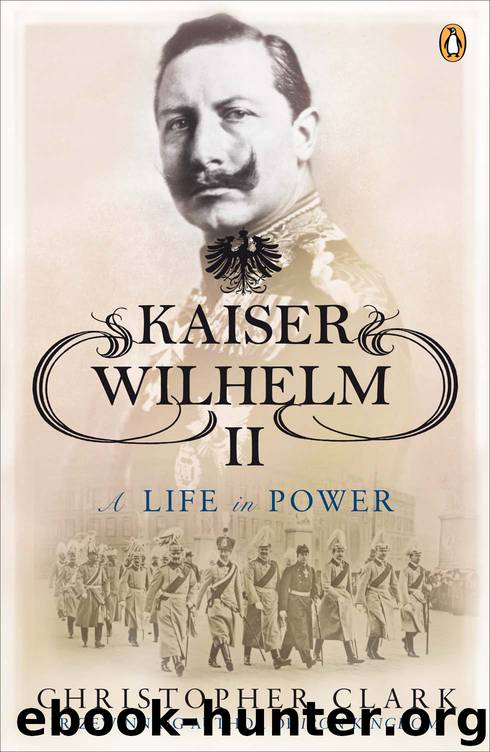
Author:Christopher Clark
Language: eng
Format: epub
ISBN: 9780141929965
Publisher: Penguin Books Ltd
Published: 2009-05-15T16:00:00+00:00
Here and there the Kaiser makes little pauses, one can see that he is reflecting, folds appear upon the brow and the eye looks out into the distance until the connecting element has been found that can serve as the natural and logical continuation of that which has already been said. Once this thought has been found, however, the speech resumes without interruption, and he is carried on a river of words until the end.14
The cultural historian Karl Lamprecht, who had seen Wilhelm in action, wrote in a similar vein of the Kaiser’s ‘full sonorous voice’, ‘an ever more lively alternation of facial expressions’ and ‘gesticulation escalating to the point of physical action’. ‘The Kaiser,’ wrote Lamprecht, ‘became a speaker from his head to his toes.’15 At this performative and technical level, then, Wilhelm displayed a certain mastery of the public word. By contrast, the content of his public utterances was often catastrophically misjudged. Indeed it would not be an exaggeration to say that far more damage was done to the emperor’s reputation – both among his contemporaries and among historians since – by what he said than by what he did or caused to be done.
The root of the problem lay partly in the direct, unedited way in which Wilhelm unbosomed himself of his current preoccupations. In November 1890, for example, on the occasion of the swearing-in of the new contingent of Guards recruits in Potsdam, Wilhelm broke with convention to deliver a personal address, in which he observed that ‘a spirit of contradiction, rebellion and insurrection’ was ‘spreading through the country’ and warned the troops never to ‘lend their ears to seducers and agitators’, for ‘they belonged to him now, and would have to be prepared to fire on their fathers and brothers if he ordered them to do so’.16 Wilhelm’s preoccupation with this theme, to which he returned periodically during the decade,17 reflected a deep anxiety about the security of the throne – a conviction, as the Dutch envoy in Berlin reported in 1901, that ‘the respect for authority amongst the people has waned since the death of Wilhelm I…’18 But the controversial comments of 1890 also reflected apprehensions that were widespread at the time. As we saw, the SPD emerged from the elections of that year as the most successful German party in terms of votes cast. Since it was widely assumed that votes for the SPD came exclusively from the German working class, the class from which new army recruits were also drawn, there were concerns about the political reliability of the army. It was a question that preoccupied not only the military policy-makers of the pre-war era, but also the Social Democrat leadership, who saw in the gradual ‘reddening’ of the military through the infusion of proletarian recruits one key to the future revolutionary transformation of German society.19
The Civil Cabinet succeeded in having a bowdlerized version of the speech circulated to the press, and thus avoided the outrage that these words might otherwise have caused.
Download
This site does not store any files on its server. We only index and link to content provided by other sites. Please contact the content providers to delete copyright contents if any and email us, we'll remove relevant links or contents immediately.
Fanny Burney by Claire Harman(26607)
Empire of the Sikhs by Patwant Singh(23090)
Out of India by Michael Foss(16860)
Leonardo da Vinci by Walter Isaacson(13340)
Small Great Things by Jodi Picoult(7152)
The Six Wives Of Henry VIII (WOMEN IN HISTORY) by Fraser Antonia(5519)
The Wind in My Hair by Masih Alinejad(5101)
A Higher Loyalty: Truth, Lies, and Leadership by James Comey(4966)
The Crown by Robert Lacey(4819)
The Lonely City by Olivia Laing(4805)
Millionaire: The Philanderer, Gambler, and Duelist Who Invented Modern Finance by Janet Gleeson(4482)
The Iron Duke by The Iron Duke(4367)
Papillon (English) by Henri Charrière(4278)
Sticky Fingers by Joe Hagan(4205)
Joan of Arc by Mary Gordon(4117)
Alive: The Story of the Andes Survivors by Piers Paul Read(4037)
Stalin by Stephen Kotkin(3973)
Aleister Crowley: The Biography by Tobias Churton(3644)
Ants Among Elephants by Sujatha Gidla(3469)
